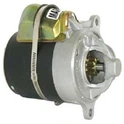

Hey there! As a supplier of Starter - Mitsubishi DD, I often get asked about how to calculate the output power of these starters. It's not as complicated as it might seem at first glance, and in this blog, I'll break it down for you step by step.
First off, let's understand what output power means in the context of a Starter - Mitsubishi DD. Output power is basically the amount of useful energy the starter can deliver to start an engine. It's a crucial factor because it determines whether the starter can handle the load of the engine it's supposed to start.
The Basics of Power Calculation
To calculate the output power of a Starter - Mitsubishi DD, we need to know two main things: torque and speed. Torque is the rotational force that the starter can generate, and speed is how fast the starter can rotate. The formula for power in rotational systems is:
[ P = \frac{2\pi NT}{60} ]
Where:
- ( P ) is the power in watts (W)
- ( N ) is the speed in revolutions per minute (RPM)
- ( T ) is the torque in Newton - meters (N·m)
Let's break this formula down a bit further. The ( 2\pi ) is a constant that comes from the relationship between linear and angular motion. The ( N ) represents how many times the starter's shaft rotates in one minute. And the ( T ) is the force that the starter applies to turn the engine's flywheel.
Measuring Torque and Speed
Now, you might be wondering how to measure the torque and speed of a Starter - Mitsubishi DD. Well, for torque, you can use a torque wrench or a torque sensor. These tools are designed to measure the amount of force required to turn an object. When testing a starter, you can attach the torque - measuring device to the starter's output shaft and apply a load to simulate the engine's resistance.
For speed, you can use a tachometer. A tachometer is a device that measures the rotational speed of a shaft. You can attach it to the starter's shaft to get an accurate reading of how fast it's spinning.
Example Calculation
Let's say we have a Starter - Mitsubishi DD with a measured torque of 10 N·m and a speed of 3000 RPM. We can use the formula above to calculate the output power:
[ P = \frac{2\pi\times3000\times10}{60} ]
First, calculate ( 2\pi\times3000\times10 ):
[ 2\pi\times3000\times10= 60000\pi ]


Then divide by 60:
[ P=\frac{60000\pi}{60}= 1000\pi\approx 3142 \text{ W} ]
So, the output power of this starter is approximately 3142 watts or 3.142 kilowatts.
Factors Affecting Output Power
There are several factors that can affect the output power of a Starter - Mitsubishi DD. One of the main factors is the voltage. Starters are typically designed to operate at a specific voltage, usually 12V or 24V. If the voltage is too low, the starter may not be able to generate enough torque to turn the engine. You can check out our 12V Starter - Mitsubishi DD for more information on 12V starters.
Another factor is the temperature. As the temperature increases, the resistance in the starter's windings also increases. This can reduce the current flowing through the starter and, in turn, reduce the output power.
The condition of the starter's components also plays a role. Worn brushes, a damaged armature, or a faulty solenoid can all decrease the starter's efficiency and output power.
Importance of Accurate Power Calculation
Accurately calculating the output power of a Starter - Mitsubishi DD is crucial for several reasons. First, it ensures that the starter is suitable for the engine it's going to be used with. If the output power is too low, the starter may not be able to start the engine, especially in cold weather or under heavy load conditions.
Second, it helps in diagnosing problems with the starter. If the calculated output power is significantly lower than the rated power, it could indicate a problem with the starter, such as a short circuit or a mechanical issue.
Different Types of Starter - Mitsubishi DD
We offer different types of Starter - Mitsubishi DD, each with its own characteristics and output power ratings. For example, our 8 - Tooth Pinion Starter - Mitsubishi DD is designed for specific engine applications. The 8 - tooth pinion provides a certain gear ratio that affects the torque and speed of the starter, and ultimately, its output power.
We also have 0.9 - 1.1KW Starter - Mitsubishi DD. These starters are rated within a specific power range, and the actual output power can be calculated using the method we discussed earlier.
Conclusion
Calculating the output power of a Starter - Mitsubishi DD is an important step in ensuring that the starter is suitable for your engine and is operating efficiently. By understanding the basic formula and how to measure torque and speed, you can accurately determine the output power of your starter.
If you're in the market for a Starter - Mitsubishi DD or have any questions about our products, feel free to reach out to us for a direct purchase negotiation. We're here to help you find the right starter for your needs and ensure that it performs at its best.
References
- Electrical Engineering Fundamentals textbooks
- Mitsubishi Starter technical manuals